What’s happening in Bromley now
Child outcomes in Bromley
Good Level of Development
Children in Bromley have a strong start in life. A higher proportion (+5%) achieve a Good Level of Development (GLD) than the national average (73.3% compared to 68.3%).
There are however notable differences in communities of children across the borough which mirrors the national picture:
- Fewer children eligible for Free School Meals (FSM) achieve a GLD than their peers.
- Fewer boys achieve a good GLD than girls.
- Fewer children whose first language is not English achieve a good GLD than their peers.
- Fewer children born in the summer term achieve a good GLD than their peers.
- Fewer children from Black/African/Caribbean or Other heritages achieve a good GLD than their peers.
- Significantly fewer children with identified SEN achieve a good GLD than their peers.
We have embraced the government’s stretching targets of ensuring that at least 80% of our children achieve a GLD and 61.5% for those eligible for FSM by 2027/28. This equates to an additional 249 children overall with an additional 31 children eligible for FSM to reach the relevant targets.
Further details are provided in Appendices A and B.
Vaccinations and immunisations
- Fewer children in Bromley receive the 6-in-1 vaccine at 12 months than the national average.
- Fewer children in Bromley receive the MMR vaccine at 2 years old than the national average.
- Fewer children in Bromley receive the MMR vaccine (single and double doses) at 5 years old than the national average.
Vaccine hesitancy and misinformation
Falling uptake weakens population (‘herd’) immunity, leaving more children unprotected, and making outbreaks like measles more likely, especially in under‑vaccinated communities and education settings.
Bromley’s Public Health Team regularly review local vaccination data with NHS partners and Immunisation Boards so we can focus support where uptake is lowest. We provide outreach and attend events in communities with lower uptake; providing information and pop‑up clinics and working closely with schools and early years settings. We also train staff across health, education and community services to have confident, supportive conversations about vaccines, addressing vaccine hesitancy and misinformation with clear, trusted advice, and encouraging families to get vaccinated on time.
Further details are provided in Appendix C.
Early years ecosystem
At the heart of this are our Early Intervention and Family Support (EIFS) and universal health visiting services. We believe that our continued investment in our early help services is critical to successfully diverting children away from statutory intervention. This gives us strong foundations to build on.
As the Family First programme evolves, this will build upon, reshaping and strengthening Bromley’s early help model, as partners commit to this new agenda.
Resources and opportunities
The following image illustrates the early help ecosystem across our borough. Split into four layers, it can help to visualise the collective nature of early help which, by working together, helps create nurturing homes and thriving childhoods:
Black – The child and the family at the centre.
Green – Support by their relatives, friends and local community that help keep them resilient and build on their own strengths.
Magenta – Universal services such as schools, GPs, employment and social support are shown in across four life areas – health, community, learning and money.
Wine – The more specialist services that dip into early help, and which families can use when they have more complex needs.
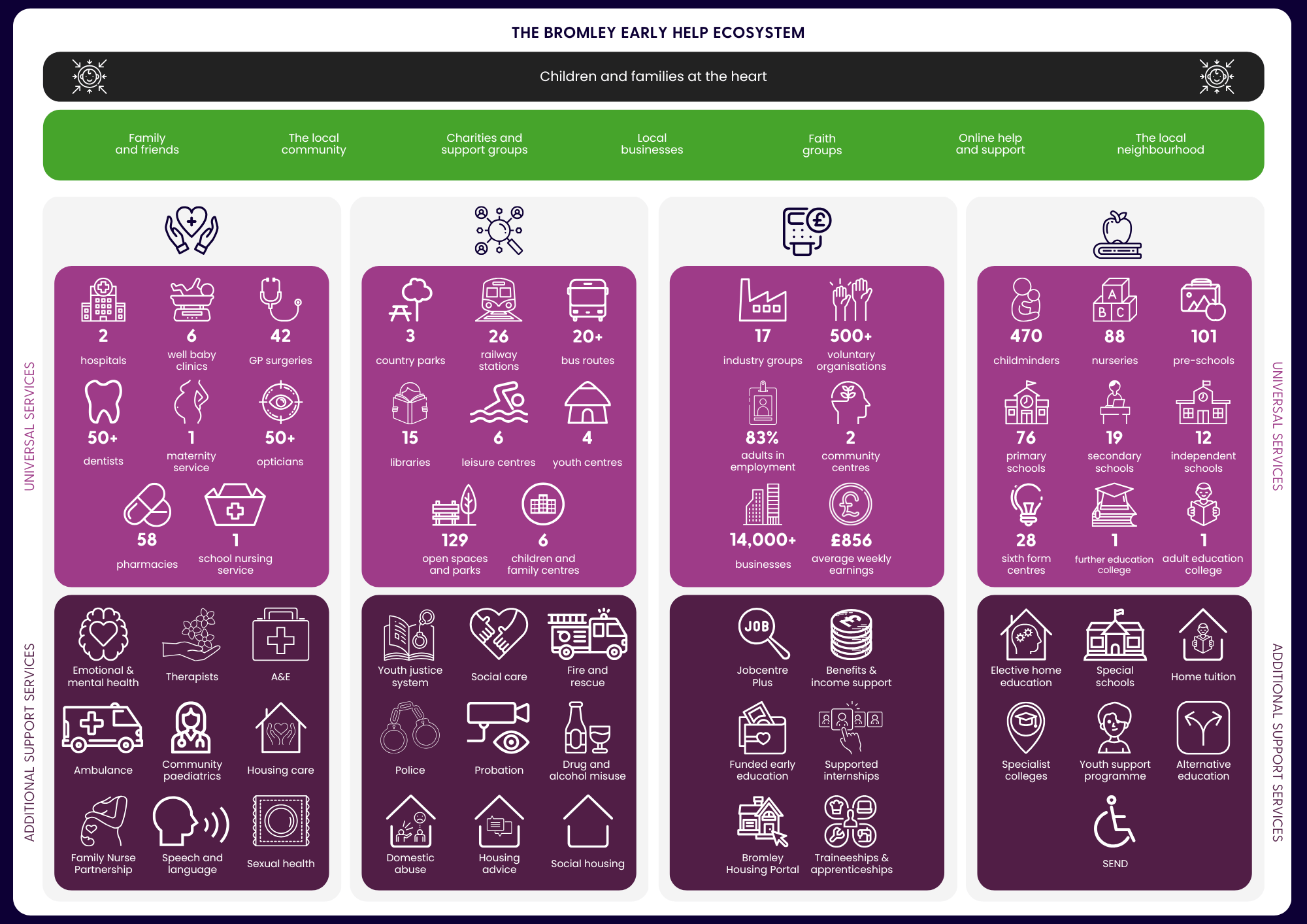
[Download image as a PDF]
Children and Family Centres
The following maps show areas of the borough with high & low numbers of young children (aged 5 and under) and those with high levels of deprivation. The third map shows the location of our existing six Children & Family Centres which are based in areas of greatest need:
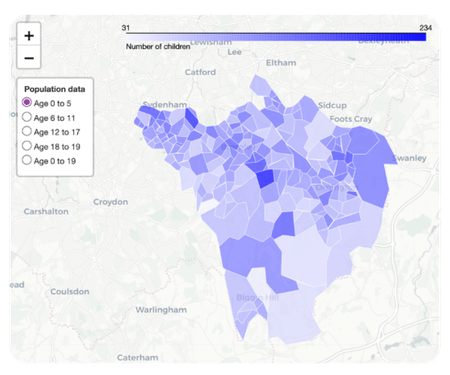
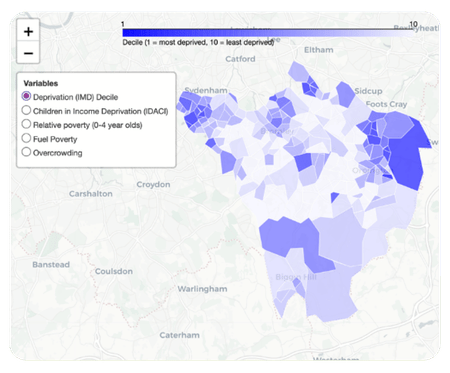
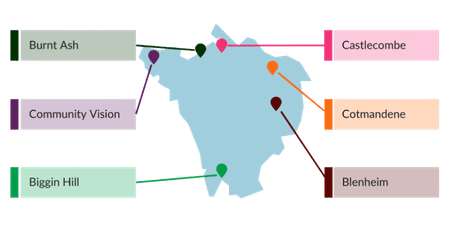
Best Start Family Hubs
Government agendas in relation to children and young people are being considered collectively, which means that this is happening alongside the wider Children’s Social Care Reforms, Integrated Neighbourhood Teams, Children’s Wellbeing and Schools Bill and Youth Matters.
Childcare and Early Education
Ensuring sufficient provision
Bromley assesses the need for childcare annually as part of its Educational Commissioning Plan. The plan provides a borough‑wide and school place planning area review of childcare for children aged 0–14. Early Years providers, schools, and parents contribute to our review of childcare sufficiency through an annual survey, enabling analysis of supply, demand, and ward‑level pressures. Resulting actions are monitored regularly and reported annually to Members. The Educational Commissioning Plan and the Ward Data Reports are published online to support provider planning and inform families about potential areas of required expansion.
Early Years Education - entitlements, quality and support
The Early Years Quality Team will continue to deliver targeted training to providers on improving the Home Learning Environment (HLE), enabling practitioners to guide families in home‑based learning activities. Collaborative work with Family Hubs will ensure consistent support for vulnerable families to improve outcomes, including children’s GLD. Termly Early Years Partnership Meetings – provider‑led and supported by the Early Years Team – serve as a regular forum for multi‑agency updates, including standing SEND items from the Early Years Inclusion Team.
Information on Early Years childcare entitlements is publicly available through the Council website, supported by leaflets for providers and families. The Early Years Childcare Information Officer assists parents in understanding local childcare options and available funding. The Early Years Team also attends outreach sessions in Children and Family Centres to promote childcare choices and early access to funded entitlements.
The Early Years Team administers the majority of Early Years SEN Inclusion Fund (EY SENIF) and Early Years Education, Health and Care Plan (EY EHCP) funding, in partnership with the Early Years Inclusion Team. The funding is allocated as part of a package of support and advice from the Early Years Inclusion Team following a referral to them for individual child. This ensures timely monthly payments to providers and ongoing monitoring of children’s progress by the Inclusion Team. The DfE provides the council with details of families potentially eligible for two‑year‑old funded places due to economic vulnerability. The Early Years Team proactively contact these families to support take‑up and signposts them to Children and Family Centres for additional support.
Annual Early Years Foundation Stage Profile (EYFSP) outcomes are reviewed by the Early Years Quality Team to identify emerging needs across the borough. Training aligned to these findings is then offered to all Early Years providers, including maintained nursery classes, to support continuous quality improvement.
Early Years Expansion Grant
We have sought to use the Early Years Expansion Grant to increase provision for 2-year-olds at private, voluntary and independent (PVI) nurseries, which make up the bulk of provision in Bromley.
National Wraparound Childcare Programme
The National Wraparound Childcare Programme, while focused on primary‑aged children, is a key enabler across several Best Start in Life themes. High‑quality wraparound childcare supports parents into sustainable employment, strengthens continuity of care for children across the early years and primary phases, and promotes a more integrated family support system. It also plays an important role in inclusive practice, particularly for children with SEND, and supports professional development across the early years and childcare workforce.
By ensuring sufficient childcare provision between 8am and 6pm during term time, the programme enables more parents – particularly mothers, single parents, and those in lower‑income or insecure employment – to take up, sustain, or extend work opportunities. This supports improved family financial resilience, reduces childcare‑related barriers to employment, and aligns with Bromley’s ambitions to strengthen family stability and independence.
As part of Bromley’s implementation approach, wraparound childcare will be developed through collaborative models involving schools, PVI settings, childminders, academy trusts, and community organisations to ensure provision that is flexible, responsive to local needs, and able to draw on the strengths of all sectors.
The programme also presents a significant opportunity to improve the way families navigate the system. Children and Family Centres act as a central point where wraparound childcare information is clearly signposted, enabling families to easily access details about availability, eligibility, and local providers. Improved parental information pathways will increase awareness, provide families access support at the earliest opportunity, and drive effective take‑up of services.
Looking ahead, Bromley will continue to integrate wraparound childcare within the broader Early Help and Best Start in Life plan, ensuring it contributes to smoother transitions between early years settings and primary school and greater access to support for families who may otherwise not engage with services.
School Based Nursery Programme
Early Years Inclusion
To strengthen support for vulnerable children, the Early Years Inclusion Team is mapping inclusive and specialist SEND provision across the borough to identify gaps and inform future planning. As part of Department for Education (DfE) School Based Nursery initiatives, Phase Three we will be prioritising school‑based nursery provision that meets the needs of younger children with SEND, focusing on both specialist and inclusive models within Bromley’s most disadvantaged areas.
Next chapter →